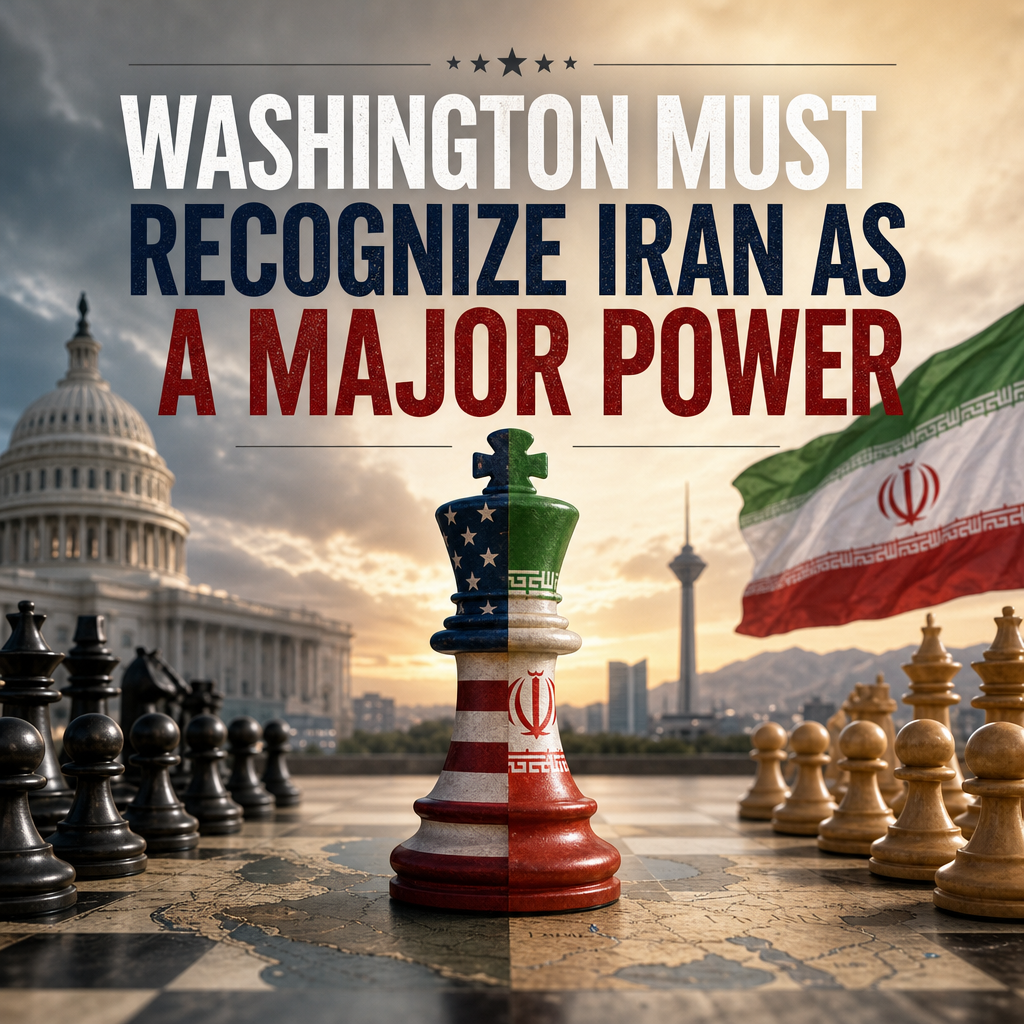
Washington Must Recognize Iran as a Major Power


Washington must recognize Iran as a major power if it wants a realistic path toward reducing tensions in the Middle East, but recognition should not mean concession, endorsement, or a blank check.
For years, U.S. policy has swung between pressure, sanctions, military deterrence, and occasional diplomacy, yet the underlying reality has barely changed: Iran is too entrenched, too influential, and too interconnected across the region to be treated as a marginal player. That is the central argument behind calls to reset Washington’s approach. But the issue is more complicated than simply accepting Iran’s weight on the board. A durable strategy must balance power politics, regional security, and the legitimate fears of Iran’s neighbors.



Why the “major power” argument matters
Iran’s influence reaches far beyond its borders. It has deep strategic ties with allied armed groups, political influence in neighboring states, and the ability to disrupt shipping lanes and regional stability. It also has a large population, a significant military apparatus, a long civilizational history, and a political system that has survived sanctions and isolation for decades. Those are not the characteristics of a small or easily coerced state.
That is why the “pressure first” approach has often produced limited returns. Sanctions have imposed severe economic costs, but they have not fundamentally changed Iran’s regional behavior or its determination to preserve strategic leverage. In fact, one of the recurring lessons from years of U.S.-Iran confrontation is that external pressure can sometimes strengthen hardliners inside Iran by allowing them to frame the conflict as national resistance.




From that angle, recognition of Iran as a major power is not an act of generosity. It is a practical acknowledgment of reality. Diplomatic frameworks tend to work better when they are built around the capabilities and interests of the actors involved rather than around hopes that one side can be isolated into submission.
What the different news perspectives reveal
A range of media coverage on Iran reflects the same tension in different ways.
RT’s framing has often emphasized the argument that Washington should accept Iran as a regional heavyweight rather than treat it as a state that can be contained indefinitely through sanctions and threats. That view presents U.S. policy as outdated and self-defeating, especially when it ignores the limits of coercion.
Al Jazeera’s coverage tends to place Iran within a wider regional context, highlighting the interconnected crises in Gaza, Lebanon, Syria, Iraq, and the Red Sea. From that perspective, Iran is not the only driver of instability, but it is undeniably part of a broader regional system in which rival powers, militias, and external actors all shape outcomes. This framing is useful because it avoids reducing everything to a single villain.
Sky News and other mainstream Western outlets usually reflect the concern that recognizing Iran’s status too openly could be interpreted as rewarding destabilizing behavior. That concern is not trivial. Iran’s support for armed proxies, its nuclear ambitions, and its confrontational rhetoric toward Israel and the United States are reasons many policymakers remain wary of any move that looks like accommodation.
Taken together, these viewpoints suggest a shared truth: Iran cannot be wished away, but neither can its behavior be ignored.
The core dilemma for Washington
The U.S. faces a strategic contradiction. It wants to prevent escalation, protect allies, limit nuclear risks, and preserve freedom of navigation. Yet it also relies on tools that often intensify the very instability it seeks to avoid.
That leaves Washington with three broad options:
– Continue the current mix of pressure and deterrence, hoping Iran eventually recalculates.
– Move toward selective engagement, recognizing Iran’s regional role while imposing firm limits on specific behaviors.
– Attempt a wider diplomatic settlement involving Iran, Gulf states, and major external powers.
The first option is the easiest politically, but it has the weakest long-term record. The second is probably the most realistic. The third is the most ambitious, but it would require trust that currently does not exist.
Recognition should come with conditions, not illusions
If Washington does recognize Iran as a major power, it should do so in a disciplined way. That means accepting that Iran has genuine strategic interests while also insisting that influence comes with responsibilities.
A serious policy would likely include several elements:
– Direct channels of communication to reduce the chance of miscalculation
– Clear red lines on attacks involving U.S. forces and civilian shipping
– Regional diplomacy that includes Iran, Saudi Arabia, and other Gulf states
– A realistic nuclear framework that limits proliferation risks without demanding total capitulation
– Pressure on proxy warfare, paired with incentives for de-escalation
This is not the same as trusting Iran. It is simply the recognition that negotiation is more effective when both sides understand the other’s power.
A more honest path forward
The most important takeaway is that recognition and approval are not the same thing. Washington can acknowledge Iran as a major power without accepting its regional interventions, and it can challenge those interventions without pretending Iran is weaker than it is.
That middle ground may sound unsatisfying, especially in a political climate that rewards toughness over nuance. But international strategy is not a morality play. It is a calculation about interests, leverage, and limits. On those terms, the case for recognizing Iran’s status is strong.
The real question is whether Washington is prepared to move from symbolic confrontation to practical statecraft. If it is not, then the cycle of pressure, retaliation, and escalation will likely continue. If it is, then recognition could become the first step toward a more stable regional order — not because Iran suddenly changes, but because U.S. policy finally becomes more realistic about the world as it is.